

AUTHOR: ILINA KACZOROWSKA
The fire happened at the club called “Pulse”, where the popular Macedonian pop band “DNK” was playing, with 650 people in attendance. At 2:30 in the morning, during the band’s performance, tragedy struck and the whole town was left in disaster. The morning after this horrific incident, when most Macedonians found out about what their fellow citizens had suffered, is a moment that surely will be remembered for the rest of their lives. That sudden feeling of shock, disbelief, sadness, confusion and – in the end – anger, is a feeling that none of us hope to experience ever again. Social media was filled with posts about more victims of the fire and new horrendous information about the details of the previous night. The band “DNK” consisted of six members and during the fire five of them lost their lives, leaving the lead singer Vladimir Blazev as the sole surviving member of the band. The other lead singer, Anderej Gjorgiev, lost his life after coming back to the club trying to save the young fans who came to his concert. The following day many of the families didn’t have information whether their loved ones were still alive, whether they were injured, and where and in which hospital they were. The hospitals in Kočani and in the whole country were filled with victims. The insufficient amount of space and appropriate hospital equipment resulted in many of the victims being transferred for treatment to hospitals in neighboring and other countries in Europe. One of those countries was Poland, which welcomed three of the Macedonian victims in the hospital in Łęczna.
In the first days after the fire, the small nation really did unite, with everybody offering their help in any way that they could. Whether that help was with financial means, people offering free places to stay for the families of the victims or bringing things needed in the hospitals, it did not matter – everybody wanted to help in any way that they could.
One question that appeared in everybody’s minds immediately after learning about the fire was: how did this happen? What caused the deadly fire killing 62 people? How could anybody let this happen? After the incident it was announced by the interior minister that the cause of the fire were indoor pyrotechnical devices used during the concert, setting the ceiling alight and thus filling the small venue with thick, toxic smoke. After this primary information, all of the other disturbing details started to follow, revealing a deeper, not-so- simple background of the situation. The nightclub lacked even the most basic fire safety infrastructure. There were no functioning sprinklers to control or slow the spread of flames, and the fire alarm system, which was probably not present at all, failed to alert organizers in time to take necessary action to save the attendees. The club had one emergency door, which was locked, leaving everybody trapped inside, with only one door through which people would be able to leave the premises.
What makes the situation even more troubling, is that the venue had undergone a number of unauthorized structural modifications. Among these were extensive interior changes that were never approved by building or safety inspectors. Most notably, illegal soundproofing materials were installed throughout the club. These materials, which were not flame-resistant and possibly even highly flammable, significantly contributed to the fire’s rapid spread. The club was operating with no licence. Underage people were let inside the club, whose whole futures were stolen during just this one night.
The incident in Kočani wasn’t just the biggest tragedy that most of us have in our country, but it was also a true picture of how the country and the system operate as a whole. “Pulse” wasn’t the only club operating in this way. On the contrary, most clubs and other institutions operate in this way. In fact, the whole system does. People on top are working without care about what will happen to the ones below them. They function in this manner and know that they won’t suffer any consequences. The tragedy in Kočani is no way an isolated event, it is a symptom of a deeply flawed and corrupt system that continues to fail its citizens. What unfolded there is not just a human tragedy, but a damning indictment of the institutions meant to protect and serve the public. From delayed emergency responses to the absence of accountability in the aftermath, every aspect of the incident reveals the deep holes in the Macedonian state.
At the core of this crisis is corruption. It is not just an individual act of bribery or negligence, it’s the structural rot that pervades public institutions. For years, warnings have been issued about the deterioration of safety standards, about underfunded fire departments, and about the misuse of public funds that were supposed to go toward infrastructure and emergency preparedness. But these warnings were ignored. It was “Pulse” on the 16th march, but it could have easily happened at numerous other locations. This knowledge alone is the main thing that scared the Macedonian nation. The knowledge that it could have been any one of us. Promptly after the feeling of grief, immediate feeling of anger filled their heads and hearts. Anger towards the whole system. Anger towards the ones who were meant to protect our youth – and instead, they failed them miserably. The feeling of anger and the need for change is in no way something that appeared there for the first time. It’s something that was felt for years and years. There were enough disappointments, tragedies and injustices for a whole lifetime. The sense that something not only needs, but must change has been lingering with for decades. This was just thе final trigger.

Оn 17th of March, the whole town of Kočani gathered on the streets to pay respects for their lost families, friends and fellow citizens. The population of Kočani is less than 25,000 citizens. In only one night they lost 62 young people. Everybody in the city either lost someone close, someone from their families, or an acquaintance. The schools were left emptier than they were before, with young students losing their friends and experiencing the worst at such a young age. When reporters talked to one of the Kočani inhabitants during the protests he said the following: Kočani is now a dead city, dead. We will need generations and generations to recover from what just happened. He explained how this affected the inhabitants in the most accurate and devastating way possible. Every one of us Macedonians were hurt, but we can never know exactly how the locals felt and are still feeling. The gathering in Kočani was truly the most heart-wrenching. The people that we saw in the front of the gathering were all young people, most of them no older than 18. The gathering turned from peace to rage, with people demanding repercussions for the ones guilty. Groups that day gathered together and completely demolished a cafe owned by the owner of the “Pulse” club. They also headed towards the municipal building, demanding for the mayor to show himself before the people.
When the crowds, including the parents of victims, were barred by the police from entering the building, objects started to be thrown, damaging the façade and breaking windows.
When it comes to taking money they are the first to show up, but when it comes to accountability, when someone should stand up in front of these people, they are nowhere to be found, shouted one of the protesters.
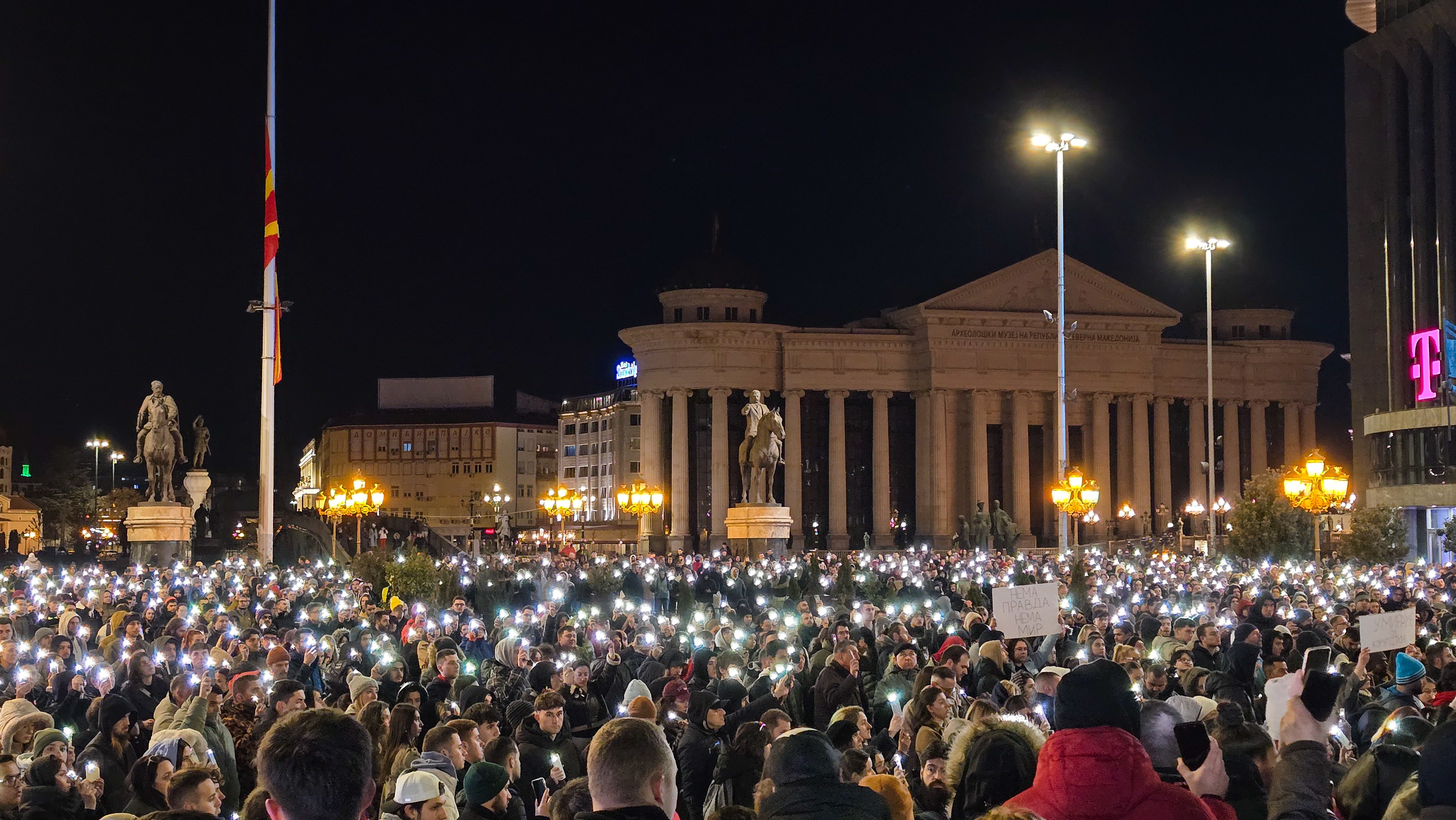
The gatherings of course didn’t stop with just Kočani. Thousands of people took to the streets all over the country – with the biggest ones being in the capital, Skopje.
In the days that followed the tragedy, a movement began to emerge. First starting with whispers all over social media, and finally, as thousands of footsteps hit the pavement of Skopje. People poured into the streets, not just to grieve, but to speak the words that were universally felt: This was preventable. This was not an accident. This is what happens when a system rots from the inside out. The main voice of this movement was a group named “Who’s Next?”. This group emerged a few months back, after a 22 year old girl was ran over on the main street of Skopje. She was pronounced dead on the spot and many from the nation felt that her killer didn’t get the right sentence and justice was not served. The name “Who’s Next” reveals a deep-rooted question and fear in the citizens. Their largest march, held on March 24 in Skopje, wasn’t loud by any means. There were no chants and no megaphones. Protesters walked in near-total silence, holding signs with the names and ages of the dead. They carried black balloons instead of flags. The march began with a three-minute silence, observed not just as a tribute, but as a form of resistance. It ended in front of the government building, where the crowd stood still for sixteen long minutes, a minute for every minute the fire raged while help failed to arrive.
At the center of it all are the young students from Macedonia. Victims of a broken system, who know that they are the ones who will be left to deal with and resolve the problems in our country. They bear the knowledge that if they want to stay and live in the country they so deeply love, they will have to be the ones to rise to the challenge and demand change. We want to stay and build our futures here, we want to be safe and to know that we will have a system and country that supports us while doing so.
This tragedy was the students’ breaking point. They walked out of lectures, gathered in parks and public squares with placards that said We study for a future that doesn’t exist, Your silence is complicity, Our generation is not disposable. They spoke not just of Kočani, but of everything it symbolized: a country where young people grow up learning that nothing is fair and that everything has a price.
The movements still continue operating. Students gather, parents of the victims of Kočani still come together and take to the streets. The tragedy is still very present in all of the lives of Macedonians. Kočani will remain a black mark in our history. The only thing we have left now is hope that we will work together for a better future for us all. That this will be a real wake up call, that it won’t be something that we will forget with no real change happening. That we will finally have a better future and a country where we would like to stay.